
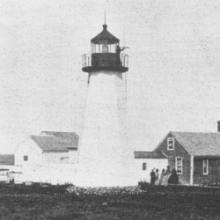
Standing on the extreme northeastern tip of Chappaquiddick Island, Cape Poge Lighthouse, even today, is remote and isolated. In 1801, when the first keeper, Matthew Mayhew, and his family moved into the tiny dwelling provided by a parsimonious Department of the Treasury, it must have seemed as isolated as a frontier outpost. Their enemy was not the "Savage," but the savage sea. Keeper Mayhew felt so insecure that even a quarter of a century later, in 1825, he wrote to Henry Dearborn, Superintendent of Light Houses for Massachusetts: "...
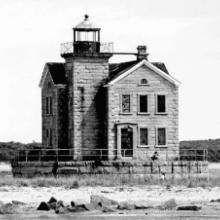
Perhaps no other light station on Long Island has experienced as many ups and downs as Cedar Island. From the glory of Sag Harbor’s whaling days and the laughter of many children, through erosion, storms, and abandonment, to the current struggle just to remain standing, this light station has had its share of good times, as well as bad.
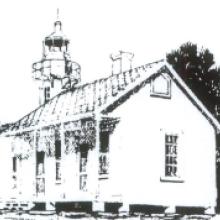
In 1802, from a wooden tower atop a magnificent 52 foot high sand dune formed thousands of years earlier as crown of the outermost island comprising Les Yslas Sabinas, Spanish Florida, a lookout shouted a warning to his Portuguese and American companions. Sailing vessels were approaching from the west. They were correctly assumed to be hostile ships of the Spanish coastal patrol cruising eastward from New Orleans.
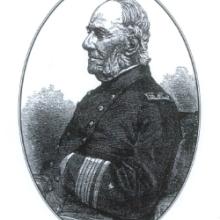
William Branford Shubrick was born in 1790 on the Belvedere plantation on Bull Island, SC. He was the ninth child of a family of sixteen. The island derived its name from Governor Bull. At the time of Shubrick's birth, the island was owned by his father, Colonel Thomas Shubrick, who had distinguished himself during the Revolutionary War. Belvedere plantation grew the prized "sea island" cotton of South Carolina. In 1852, as the first Chairman of the Lighthouse Board, William Shubrick authorized the construction of a lighthouse on Bull Island known as the Bull's Bay Light Station.
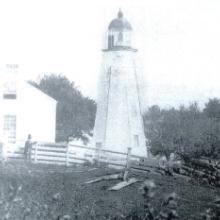
The Port of Genesee was established by President Thomas Jefferson in 1804. The port district stretched approximately 70 miles along Lake Ontario's south shore, from Oak Orchard to Sodus Bay, New York. The port's center was where the north flowing Genesee River met Lake Ontario, a marshy bay guarded by two sand bars. President Jefferson appointed Samuel Latta to be Collector of Customs. In the first year he gathered $22.50 in revenue compared to expenses of $24.00. From that small beginning, the port would grow to be one of the busiest on the south shore of Lake Ontario.
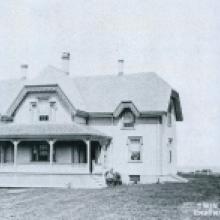
The history of Cape Cod's second lighthouse is (as was with the first at Highland) that of encroaching seas. Since 1808 its position has twice retreated before winter storm induced erosion. The next logical location for a lighthouse on Cape Cod, after the Cape Cod station at Highland, was along the Chatham shore. A light at this location would assist mariners make the passage from Nantucket Sound around the cape.
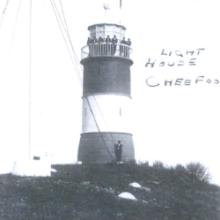
The length of China's coastline between the North Korean and Vietnamese borders varies depending on which source you consult-approximately 14,500 km (9,000 miles), according to some; approximately 18,000 km (over 11,100 miles), say others. The coastline is very rugged in some areas, and there are literally thousands of islands, rocks and reefs, both inshore and offshore, especially in the central region (roughly between Shanghai and Hong Kong).
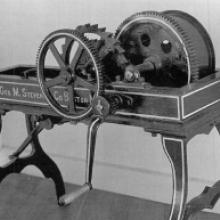
What do church steeples and fog signals have in common? Well in many cases, a strange "Rube Goldberg" looking machine filled with gears, cables, fan-blades and a giant sledge hammer. We are talking about the tower clockwork in the case of a church and a fogbell striker in the case of a fog signal.
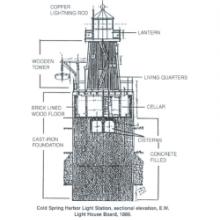
Congress was quick to respond to the 1874 petition for establishing a lighthouse at the entrance of Cold Spring Harbor but it would be another 15 years before construction began. The appropriation, which amounted to $20,000, called for erecting either range lights or a lighthouse. The Light House Service preferred range lights since, it was reasoned, the beacons would allow mariners to more easily avoid the shallows on the west side of the harbor's entrance.
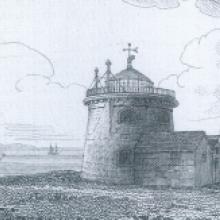
Before the advent of photography the best way to present images in multiple copies to readers of books and newspapers and to art collectors was the print, usually made by pressing onto paper an engraved or etched plate of metal that had been inked. Starting in the seventeenth century and continuing until the early twentieth, many thousands of prints were produced. Some of them were of considerable artistic value, created by engravers of distinction. Displaying framed prints, often colored or tinted, on the walls of one's residence was considered to be a mark of sophistication and culture.